President Trump final week launched a nationwide safety technique laying out his imaginative and prescient for America’s position on the planet, tempering U.S. help for longstanding allies and recasting U.S. world pursuits in enterprise phrases.
China took be aware.
The paper’s part on Asia, virtually solely dedicated to China and the specter of battle over Taiwan, concludes with an crucial to win “financial and technological competitors” within the Indo-Pacific.
However the doc presents no strategic plan on how you can bolster U.S. alliances and an infrastructural base unprepared for a battle this decade. And it by no means as soon as mentions the race towards China for superiority in synthetic intelligence.
Three days after releasing the doc, Trump introduced that Nvidia, the world’s most precious firm and main chip maker, may start promoting highly effective chips to China — the sort of chips key to powering AI. Trump’s transfer broke with a long time of U.S. export management coverage he as soon as supported.
It was a welcome sequence of occasions in Beijing, the place Chinese language-state media interpreted Trump’s actions as an “inward retrenchment” — pragmatic steps from a shrinking superpower, targeted on U.S. commerce within the area above all else. The president’s strikes come because the White Home has tried to decrease tensions with Beijing triggered by Trump’s tariff hikes.
Trump alluded to financial considerations when he defined the choice on chips with a social media put up: “We’ll shield Nationwide Safety, create American Jobs, and maintain America’s lead in AI.”
Trump’s new technique “differs from the fashion of the primary time period, which emphasised ‘nice energy competitors,’” one Chinese language evaluation learn, “and shifts towards an inward and home focus, emphasizing ‘America First.’”
One provision of the paper instructed Trump would undertake a , asserting U.S. affect over the Western Hemisphere whereas permitting different regional powers — corresponding to Russia and China — to claim dominance in their very own backyards. Different parts described China’s risk to Taiwan in purely financial, not army, phrases.
“The doc adopts softer language and shifts its declaratory coverage from ‘opposes’ to ‘doesn’t help’ any unilateral change to the established order within the Taiwan Strait,” stated Tong Zhao, an skilled on China on the Carnegie Endowment for Worldwide Peace. China views Taiwan as a breakaway province and has lengthy spoken of reuniting with the mainland.
“China has shifted from merely opposing Taiwan independence to proactively selling unification, and is now not glad with merely sustaining the established order,” Zhao stated. The softer wording, he added, “may sign to Beijing a weaker U.S. dedication to preserving that established order.”
It’s a strategic course with few adherents in Washington.
For many years, U.S. presidents have maintained a coverage of strategic ambiguity with China over Taiwan, suggesting that Washington would defend the island towards Chinese language army motion with out explicitly outlining its plans.
However Republican lawmakers on Capitol Hill have inspired Trump to take the other tack, abandoning strategic ambiguity and recognizing Taiwanese independence. And this week, senior GOP senators spoke out towards the president over his determination to permit Nvidia to promote chips into China.
Rush Doshi, a former Biden administration official now at Georgetown College’s Faculty of International Service, stated it was a “huge deal” that China isn’t even talked about within the nationwide safety technique till the nineteenth web page.
“It’s additionally a big departure from the primary Trump time period and the Biden administration,” Doshi stated. “The purpose is to stabilize relations with China reasonably than compete to safe American pursuits.”
A diplomat with the Chinese language International Ministry reacted cautiously to the Trump administration’s current strikes, telling reporters that each international locations “stand to achieve from cooperation and lose from confrontation.”
“The precept of mutual respect, peaceable coexistence, and win-win cooperation is the correct means for the 2 international locations to get alongside,” stated Guo Jiakun, spokesperson for the International Ministry, “and is the one lifelike alternative.”
Taiwanese officers declined to remark, however pointed to an official assertion from their International Ministry that stated that the Trump administration “has continued to indicate help for Taiwan” with its nationwide safety technique.
The assertion stated Taiwan was dedicated to working with the US and bolstering its protection capabilities, including, “these actions show to the worldwide neighborhood Taiwan’s steadfast willpower to guard itself and preserve the established order.”
‘Army overmatch’
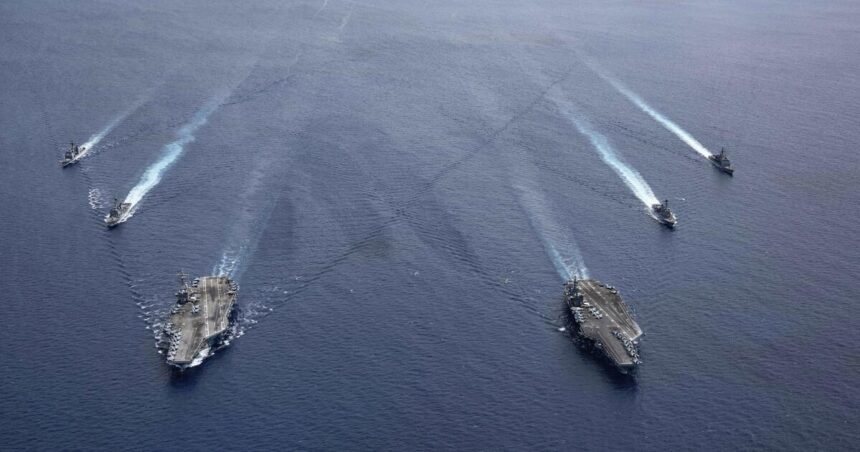
Trump’s safety technique emphasizes the necessity to deter a battle over Taiwan to protect world delivery routes within the area, stating the US “will construct a army able to denying aggression wherever within the First Island Chain” — a strategic ring of islands off the east coast of China, together with Taiwan.
“Deterring a battle over Taiwan, ideally by preserving army overmatch, is a precedence,” the paper reads.
An inner Pentagon evaluation first reported by the New York Occasions this week discovered the U.S. army had misplaced its strategic edge over China, and that its forces can be outgunned, or overmatched, in a direct battle within the South China Sea. A protection official confirmed the veracity of the report back to The Occasions.
Pledges by the Trump administration to remodel the U.S. army, and notably the Navy, in time for such a battle could also be too little, too late, with Chinese language President Xi Jinping directing the Chinese language military to be able to reclaim Taiwan by 2027. And China’s quickly increasing army capabilities on land and sea have shortened the warning time that Washington and its allies must come to Taiwan’s protection.
“The issue is, the lead time to organize is getting shorter and shorter,” one Australian diplomat informed The Occasions. “We received’t have a lot discover.”
Oriana Skylar Mastro, a strategic planner on China for U.S. Indo-Pacific Command and a fellow at Stanford College, stated the doc’s language on defending the First Island Chain is per that of previous administrations — however leaves out particulars on the way it plans to hold that out.
“The USA must put money into the correct applied sciences, and must construct the correct weapons, extra of them — after which work out the place to put them,” Mastro stated. “A part of the problem could also be political, however for probably the most half, it’s simply geography. There’s little or no landmass within the fight radius of Taiwan, and people areas — southwest Japan, northwest Philippines — are already saturated [militarily]. There’s simply not lots of area to place stuff.”
The administration’s technique additionally supplies China with a street map to retake Taiwan in a means that Trump might be able to settle for, Zhao stated, permitting Chinese language dominance over the island whereas pledging to take care of freedom of navigation all through the area.
The administration’s method to the realm follows “mercantile logic,” Zhao stated, offering Beijing with a path ahead on unification that would keep away from U.S. intervention — impressed by Russia’s efforts to woo Trump and his aides away from American commitments to Ukraine with guarantees of commerce offers, monetary alternatives and financial cooperation.
“If Washington was prepared to tacitly settle for China’s sovereignty claims over disputed options throughout the South China Sea,” Zhao stated, “Beijing would have little incentive to threaten business navigation.”
What else try to be studying
The must-read:
The deep dive:
The L.A. Occasions Particular:
Extra to return,
Michael Wilner
—
Was this text forwarded to you? to get it in your inbox.